

All
- All
- Product Management
- News and Information
- Introduction content
- Enterprise outlets
- Frequently Asked Questions
- Corporate Video
- Company Portfolio
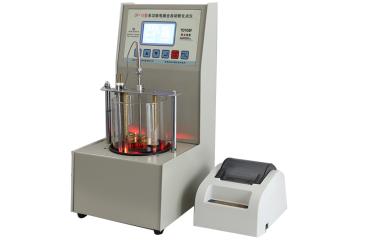
Introduction to the Operating Instructions for the Asphalt Softening Point Tester
2020-07-22
The operating instructions for the asphalt softening point tester are as follows:
Place the metal ring onto a glass plate coated with a glycerin-talc powder separator (glycerin:talc powder = 2:1). Heat the bitumen (for petroleum bitumen, heat to ≤ the estimated softening point + 90℃; for coal bitumen, heat to ≤ the estimated softening point + 50℃), then pour the heated mixture into the metal ring, slightly above the ring’s surface. After pouring, allow the mixture to cool and solidify.
If the softening point of the sample is estimated to be higher than 120℃, both the metal ring and the metal plate (but not the glass plate) should be preheated to 80℃ and 100℃, respectively.
After letting it sit at room temperature (15℃–30℃) for at least 30 minutes, use a hot scraper to remove the sample from the ring surface, ensuring uniformity across the ring surface.
The metal ring and glass plate (or metal plate) containing the sample shall be placed in a thermostatic bath containing either clean water (with a softening point estimated to be below 80℃) or glycerin (with a softening point estimated to be above 80℃) for at least 15 minutes. The water temperature shall be 5 ± 0.5℃, while the glycerin temperature shall be 32 ± 1℃. Meanwhile, the steel ball, the steel ball positioning ring, and the replacement rack shall also be kept under the same water or glycerin conditions for at least 15 minutes.
Fill a glass beaker with a nominal volume of 600 ml with freshly boiled distilled water or glycerin at 32 ± 1℃, then cool it to 5 ± 0.5℃. The liquid level should be slightly below the deep mark on the vertical rod of the ring stand where the beaker will be placed.
The metal ring containing the sample is placed over the circular hole at the top of the ring holder. The steel ball positioning ring is then covered. The entire ring holder is placed in a beaker, and the liquid level is adjusted to the water-depth mark on the vertical rod while maintaining the corresponding temperature. No bubbles should adhere to any part of the ring holder.
The thermometer (with a measurement range of 0–100℃ for water and 0–200℃ for glycerin) is inserted vertically into the central circular hole in the top plate, ensuring that the bottom of the mercury bulb is level with the bottom beneath the metal ring.
Move the beaker onto the cotton-mesh temperature-controlled electric furnace, then place the steel ball on the sample. Immediately turn on the electric furnace to heat the liquid in the beaker, maintaining the liquid temperature at around 3 minutes and increasing it by 5 ± 0.5℃ per minute.
When the specimen is heated and softened and comes into contact with the surface of the lower plate, record the temperature of the lower plate, and take the average of two readings from the same test as the test result.
Immediately after the experiment is completed, turn off the electric furnace and disconnect the power supply. Use a cotton mesh to transfer the beaker to the workbench, then pour out the water contained in the beaker (if the liquid is glycerin, allow it to cool before recovering the uncontaminated portion; the remaining portion can be disposed of together with the water). Remove the asphalt sample, wash the metal ring, steel ball positioning ring, steel ball, and ring frame. Immerse cotton gauze in gasoline, then wipe them dry with another piece of dry cotton gauze. Apply a thin layer of grease to prevent rusting.
Relevant Information

The main advantages of the penetration tester are:
The main advantages of the penetration tester are:
2023-11-02

The working principle of the compaction apparatus mainly includes the following points:
The working principle of the compaction apparatus mainly includes the following points:
2023-10-23

The compaction instrument is a device used to measure the bearing capacity of bored pile foundations. Its main features are as follows:
2023-10-13