

All
- All
- Product Management
- News and Information
- Introduction content
- Enterprise outlets
- Frequently Asked Questions
- Corporate Video
- Company Portfolio
What are the test steps for the asphalt ductility tester?
2020-07-15
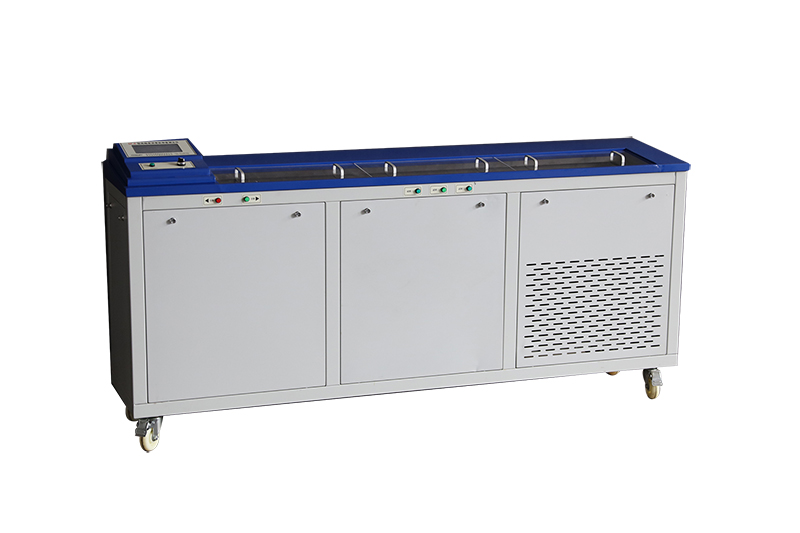
The asphalt ductility tester places an asphalt specimen of a specific shape and size into a water medium maintained at a stable temperature, then stretches it at a constant rate until the specimen breaks. The length of the specimen at the moment of breakage is referred to as the asphalt ductility, with the unit being centimeters.
The test procedure for the asphalt ductility tester is as follows:
(1) This instrument should be placed horizontally on a surface at room temperature between 0 and 40℃, with relative humidity no greater than 80%, free from vibrations and corrosive gases, and must have proper grounding protection.
(2) Fill the sink with water, ensuring that the water level meets the requirements of the test operating procedures.
(3) After connecting the power and confirming that the instrument is functioning properly, set the temperature required for the test, then activate the cooling or heating system. At the same time, press the “Cycle” button to start the water pump; once the set temperature is reached, the system will automatically stop operating.
(4) Turn the transmission lever to “Neutral,” then move the transmission and place the mold filled with the sample into the cylindrical pin at the extension end of the instrument. Rotate the lever to the “Fast” or “Slow” gear to engage the gears and bring the unit into working condition.
(5) Once everything is ready, press the test button to start the instrument. The display will show the elongation length. During the test, if you notice asphalt filaments floating on the water surface or sinking to the bottom of the槽, add alcohol or table salt to adjust the specific gravity of the water to match that of the sample, then continue the test.
(6) When the asphalt specimen is broken or reaches the test requirements, press the “Record” button. The instrument will automatically record the elongation of that specimen. When the second specimen is broken, press the “Record” button again, and the instrument will automatically record the elongation of that specimen as well. Similarly, after the third specimen is broken, press the “Record” button once more, and the instrument will record the elongation of that specimen. At the same time, the instrument will automatically calculate and display the average elongation of the three specimens.
(7) After the test is completed, turn off the power, remove the test mold, set the gearbox lever to “neutral,” and push the gearbox back into place.
(8) Open the drain valve to completely empty the tank, dry the instrument thoroughly, and apply an appropriate amount of machine oil to all moving parts and gear areas to prevent rusting. If the instrument is not to be used for an extended period, be sure to cover it with a dustproof cover to protect it from dust.
Relevant Information

The main advantages of the penetration tester are:
The main advantages of the penetration tester are:
2023-11-02

The working principle of the compaction apparatus mainly includes the following points:
The working principle of the compaction apparatus mainly includes the following points:
2023-10-23

The compaction instrument is a device used to measure the bearing capacity of bored pile foundations. Its main features are as follows:
2023-10-13