

All
- All
- Product Management
- News and Information
- Introduction content
- Enterprise outlets
- Frequently Asked Questions
- Corporate Video
- Company Portfolio
Test Method and Precautions for Asphalt Extensibility Tester
2020-05-14
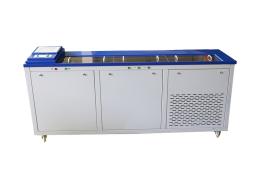
The asphalt ductility tester features an elegant and sophisticated exterior design, with durability thoroughly taken into account. It is equipped with a single electric heating element inside the inner chamber and a complete refrigeration system. Data acquisition and control are handled by either an internal display screen or a computer, ensuring automatic and convenient data storage. Utilizing frequency conversion control technology, the instrument’s housing is meticulously crafted from imported stainless steel through precision bending. It employs an LCD-controlled dual-screw mechanism, offering high precision in displacement and movement as well as enhanced safety and reliability. The tester can move at a constant speed of 5 cm per minute from one end to the other, steadily pulling standard specimens housed in the test mold within a water bath until they break, thereby determining the ductility value of the specimen.
The digital display temperature controller can directly control both heating and cooling systems. The water temperature in the tank can be precisely maintained within a range of 0–50℃ and is continuously adjustable. Additionally, it features a flow-guided circulating water system that effectively ensures uniform water temperature throughout the tank.
The extensometer’s digital display directly shows the elongation length and can automatically calculate the average value of the elongation for three specimens simultaneously. It features convenient operation, stable pulling speed, minimal vibration, and low noise.
Test Method and Precautions for Asphalt Extensibility Tester
Preparatory work:
(1) First, thoroughly mix the release agent and apply it evenly to the bottom plate of the figure-8 mold as well as to the inner surfaces of the figure-8 mold. Then, assemble the mold into a figure-8 shape and place it on the mold’s bottom plate.
(2) Heat the dehydrated sample, sieve it, and thoroughly stir until all air bubbles are completely removed. Then, repeatedly move the sample back and forth from one end of the mold to the other, slowly pouring it into the mold and slightly overfilling the mold.
(3) After the specimen has been cooled at room temperature for 30 minutes, place it in water at the specified test temperature for another 30 minutes. Then, remove the specimen and use a hot scraper to remove any excess asphalt that extends beyond the mold, ensuring that the asphalt is neatly aligned with the mold.
(4) Place the specimen together with the mold baseplate into a water bath whose temperature is maintained at the specified test temperature for 1 to 1.5 hours.
Experimental steps:
(1) The asphalt ductility tester shall be placed horizontally indoors on a floor that is free from vibration and corrosive gases, with an ambient temperature ranging from 0 to 40℃ and relative humidity not exceeding 80%. It must also be equipped with proper grounding protection.
(2) Before use, check that the water level in the sink meets the requirements specified in the test operating procedures. With all function switches turned off, connect the power supply and verify that the stirring motor and the extension power motor are functioning properly.
(3) Set the temperature controller to the desired temperature, turn on the switch for the cooling or heating system, and simultaneously start the stirring motor.
Relevant Information

The main advantages of the penetration tester are:
The main advantages of the penetration tester are:
2023-11-02

The working principle of the compaction apparatus mainly includes the following points:
The working principle of the compaction apparatus mainly includes the following points:
2023-10-23

The compaction instrument is a device used to measure the bearing capacity of bored pile foundations. Its main features are as follows:
2023-10-13