

All
- All
- Product Management
- News and Information
- Introduction content
- Enterprise outlets
- Frequently Asked Questions
- Corporate Video
- Company Portfolio
A Brief Analysis of the Composition, Installation, and Usage of the Asphalt Extensometer
2020-05-06
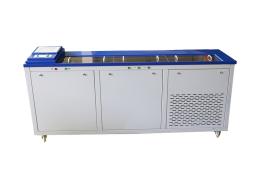
The asphalt ductility tester places an asphalt specimen of a specific shape and size into a water medium maintained at a constant temperature, then stretches it at a constant speed. The length of the specimen measured when it breaks is referred to as the asphalt ductility, with the unit being centimeters.
The asphalt ductility tester mainly consists of a mechanical tensile device, a temperature control unit, and an LCD display section.
1. The mechanical stretching device is driven by a low-speed motor and moves from one end to the other via a transmission gear rack connected to a gearbox. The transmission system is also equipped with a variable-speed mechanism, allowing for two different stretching speeds.
2. The temperature control unit consists of a refrigeration system (including a compressor, condenser, fan, etc.) as well as a heater, water pump, and water tank. By means of water circulation driven by the pump, the water temperature in the tank can be maintained at a constant and adjustable level between 5 and 50°C.
3. The extensometer LCD display can directly show the elongation of three specimens and automatically calculate and display the average elongation of the three specimens.
Asphalt Extensibility Tester Installation and Operation:
1. Open the packaging box and check the instrument’s exterior and associated accessories according to the instrument kit and technical documentation. If there is no damage or missing parts, proceed with installation as shown in the structural diagram.
2. Check whether the power ground connection is secure.
3. Turn on the power switch; the indicator light will illuminate, and you can then begin the experimental operation.
4. Wash and dry the sample cup with a solvent, then place it on the stand.
5. Install the thermometer by inserting it vertically into the sample cup, with the bulb of the thermometer approximately 6.5 mm above the bottom of the cup and positioned on the side opposite the igniter, near the cup’s edge.
6. After preparing the sample, pour it into the sample cup up to the marked line, ensuring that no other parts of the sample cup are contaminated with asphalt.
7. All equipment should be placed in an indoor location with subdued lighting and no significant air circulation, and should be enclosed on three sides by wind shields.
8. Connect the igniter to the pressurized container of flammable gas using a flexible hose. Turn the igniter to one side, perform an ignition test, and adjust the flame to form a small, spherical pilot flame that conforms to the standard spherical shape.
Relevant Information

The main advantages of the penetration tester are:
The main advantages of the penetration tester are:
2023-11-02

The working principle of the compaction apparatus mainly includes the following points:
The working principle of the compaction apparatus mainly includes the following points:
2023-10-23

The compaction instrument is a device used to measure the bearing capacity of bored pile foundations. Its main features are as follows:
2023-10-13