

All
- All
- Product Management
- News and Information
- Introduction content
- Enterprise outlets
- Frequently Asked Questions
- Corporate Video
- Company Portfolio
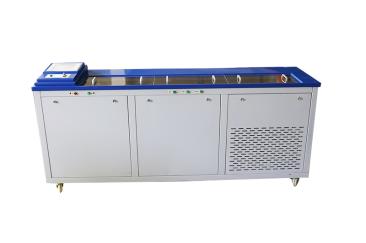
Common Faults and Troubleshooting Methods for Asphalt Extensometers
2020-08-18
The common faults and troubleshooting methods for the asphalt ductility tester are as follows:
1. Fault: The leakage current protector trips when the power is turned on.
Reason: The residual-current device (RCD) detection system monitors ground current. Since this instrument requires grounding to operate, some units may cause the RCD to trip.
Solution: Bypass the power supply through the residual-current device (RCD) or replace the RCD with one that allows a higher leakage current.
2. Fault: Slight electrical leakage from the housing of the asphalt ductility tester.
Reason: The instrument's grounding is unreliable.
Solution: Inductive loads may induce static electricity on the instrument’s casing. To ensure reliable grounding, connect the instrument’s rear grounding terminal to earth using a wire with a cross-sectional area of at least 2 square millimeters. A more reliable grounding method is to wrap the grounding wire around a radiator or bury it directly in the ground. The simplest and most feasible way to eliminate leakage current is to swap the positions of the neutral and live wires in the power cord.
3. Fault: Cannot automatically return to the home position.
Reason: The limit switch at the starting point is damaged.
Solution: Open the machine cover and replace the limit switch on the starting-side end.
4. Fault: The compressor starts but fails to cool or the cooling speed is very slow, or the compressor fails to start.
Reasons: The condensing fan is positioned too close to the wall, resulting in poor ventilation; the compressor is lacking refrigerant; and accumulated refrigeration oil makes it difficult for the compressor to start.
Solution: The instrument’s position needs to be adjusted to ensure proper ventilation, and a professional refrigeration engineer should be called in for repairs.
5. Fault: The transmission shaft is making an unusual noise.
Solution: The guide rails and transmission shaft are poorly lubricated; please add lubricant.
6. Fault: The drain valve is leaking.
Solution: Remove the valve, wrap it with waterproof tape, and then tighten it again.
7. Fault: The motor does not rotate, the tensile test cannot be performed, and the manual function has also failed.
Solution: The inverter is damaged; replace it with an inverter of the same model.
Relevant Information

The main advantages of the penetration tester are:
The main advantages of the penetration tester are:
2023-11-02

The working principle of the compaction apparatus mainly includes the following points:
The working principle of the compaction apparatus mainly includes the following points:
2023-10-23

The compaction instrument is a device used to measure the bearing capacity of bored pile foundations. Its main features are as follows:
2023-10-13