

All
- All
- Product Management
- News and Information
- Introduction content
- Enterprise outlets
- Frequently Asked Questions
- Corporate Video
- Company Portfolio
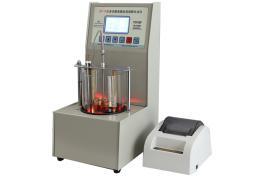
A Brief Discussion on the Operating Procedures for the Asphalt Softening Point Tester
2020-04-03
Today, the editor is here to share with you the operating procedures for the asphalt softening point tester, hoping it will be helpful to everyone.
1. Place the specimen ring onto a metal surface coated with a release agent.
2. Heat and melt the asphalt sample (the heating temperature should not exceed the sample’s estimated softening point by more than 100℃; use a thermometer ranging from 30 to 200℃ to monitor the temperature). Stir, dehydrate, and filter the melted asphalt until it flows smoothly. Then, pour the asphalt into a brass ring placed on a base, slightly above the rim of the ring. (If the estimated softening point is above 120℃, first preheat both the specimen ring and the metal plate to between 80 and 120℃.)
3. Allow the specimen to cool in air for 30 minutes, then use a heated knife to scrape off any excess material that protrudes above the ring surface, bringing it flush with the ring.
4. Place the specimen containing the test sample horizontally into the hole in the upper bearing plate. At the same time, position the locating ring onto the upper bearing plate (perform these steps for both rings simultaneously). Then, place the steel ball into the hole of the locating ring. Insert the thermometer, ranging from 0 to 100°C, through the central hole in the cover, ensuring that the spherical end rests in the central hole of the upper bearing plate. Next, place the ring holder into a beaker filled with either water or glycerin—use water if the estimated softening point of the sample is below 80°C; use glycerin if it exceeds 80°C. The liquid level should be slightly below the markings on the suspension rod. Maintain the water temperature at 5 ± 0.5°C and the glycerin temperature at 32 ± 1°C, and keep the temperature constant for 15 minutes. (If it is difficult to maintain the temperature in the beaker, place the beaker containing the ring holder into a water bath for insulation.)
5. Remove the ring holder, place the positioning ring on the lower support plate over the specimen, and position the sphere in the central hole of the positioning ring. Adjust the water or glycerin level so that it aligns with the mark on the suspension rod, and maintain the water temperature at 5 ± 0.5℃ (or the glycerin temperature at 32 ± 1℃). No air bubbles shall be present anywhere on the ring holder or any other part of the instrument equipment operating procedure RJJZ-TX-ZY-0201~0242.
6. Transfer the beaker onto a tripod stand equipped with an asbestos wire mesh and begin heating. At the same time, place the steel ball into the hole of the positioning ring (ensuring that the plane of each specimen ring remains horizontal). Immediately start heating, so that the temperature of the water or glycerin in the beaker is controlled to rise by 5–0.5℃ per minute within 3 minutes. Throughout the entire experiment, the temperature rise rate must not exceed this range; otherwise, the experimental results will be affected, and the experiment will need to be repeated.
7. The temperature at which an asphalt specimen, after being heated and softened, begins to sag until it just touches the lower support plate is defined as the softening point of that specimen.
8. For each sample, conduct at least two test specimens and take their arithmetic mean as the softening point of that specimen. The allowable error for parallel test results obtained using the asphalt softening point tester shall not exceed the limits specified in the following table:
Softening Point (°C) | Allowable Error (°C)
---------------------|-----------------------
Below 80 | Equal to or above 80 | ±2°C
Relevant Information

The main advantages of the penetration tester are:
The main advantages of the penetration tester are:
2023-11-02

The working principle of the compaction apparatus mainly includes the following points:
The working principle of the compaction apparatus mainly includes the following points:
2023-10-23

The compaction instrument is a device used to measure the bearing capacity of bored pile foundations. Its main features are as follows:
2023-10-13